Read This Before You Search For A Therapist
Finding a therapist can be a daunting process. Finding a therapist that is a good fit for you can feel like trying to throw a dart at a board while blindfolded - the success rate is low, and the possibility of risk (wasted time, resources, and momentum) is high. Rather than typing in a generic Google search, such as "therapists near me," developing a detailed picture of the therapist or therapy that suits your unique self and needs will improve your aim and increase your likelihood of hitting that target. So, how do we develop this picture?
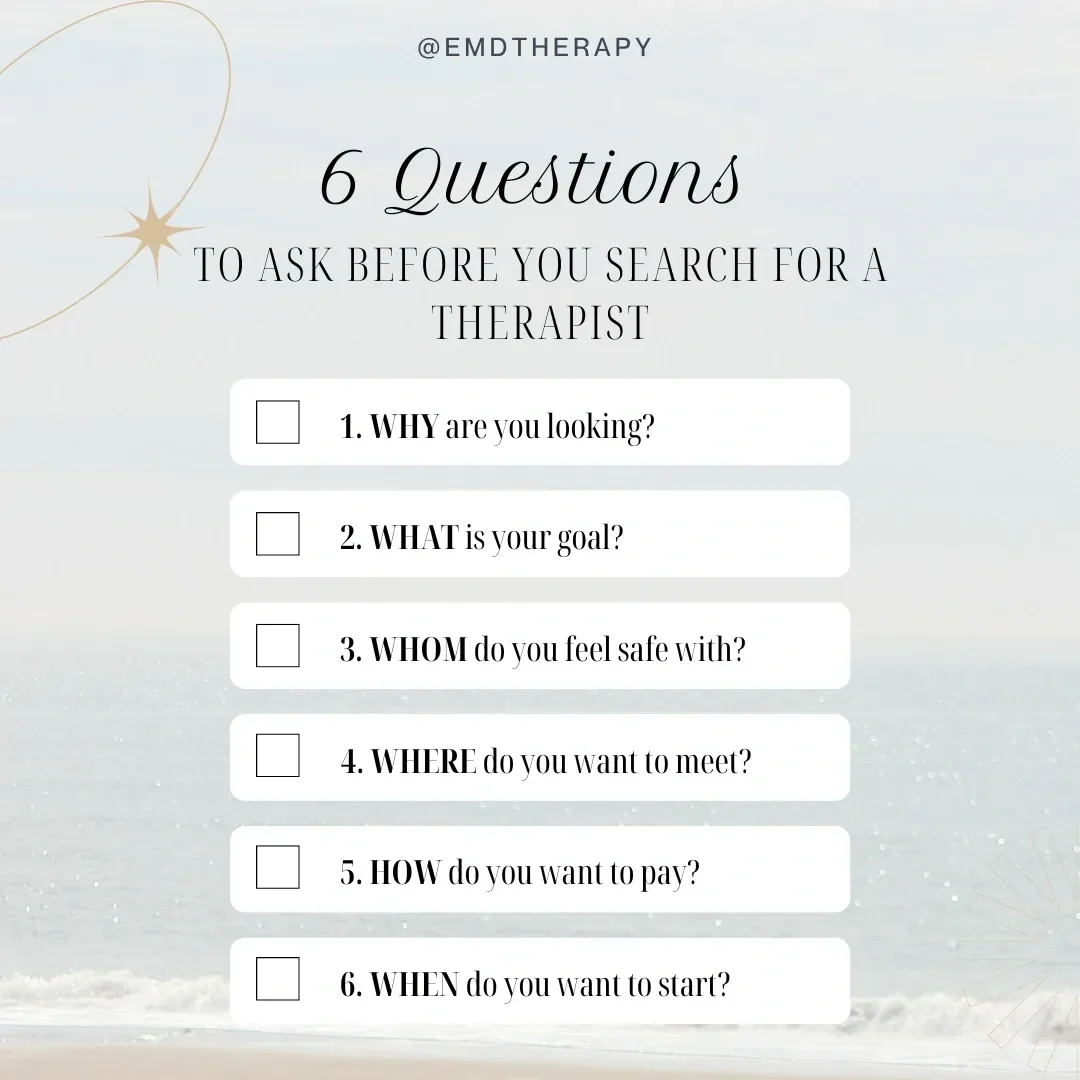
Read on for six questions that can help narrow and optimize your search.
Before beginning this exercise, I recommend writing down these questions and your answers using pen and paper. Research shows that writing ideas manually increases our focus and leads to increased brain activity - aka, it's an optimizing hack within this optimizing exercise. Now, on to the questions:
1. Why are you looking for a therapist?
“Why are we starting with why?” you may ask. Well, discerning why we are looking for a therapist can help ensure we're looking for help in the right place. It can also help us identify any barriers we need to tackle before the search takes way. Some additional questions to consider are:
Why now?
What is motivating you to seek treatment?
Has there been a recent event in your life that has prompted you to want to start therapy? Alternatively, has there been a recurring issue you have been unable to resolve on your own?
Is someone encouraging, pressuring, or requiring you to start therapy? Or are you voluntarily looking?
2. What is your goal?
A natural follow-up to the “why” is the “what.” Often, this question is easier to answer than the why. Clarifying our goals, hopes, and/or expectations for starting therapy will also ensure that psychotherapy is the appropriate avenue for seeking help. Answering this question can also help us weed out clinicians who may not have the relevant framework or experience.
Another way to answer this question is to ask:
What do you hope will change by attending therapy?
What gaps are in your life that you haven't been able to fill?
It's necessary to identify whether you are looking for a quick fix, have a narrow, specific goal, and/or have a time-limited or immediate need. If you answer yes to any of these questions, you may want to look for a counselor instead of a psychotherapist. Check out this helpful article by Nancy Schimelpfening from Verywell Mind for an overview of the differences between the two professions.
3. Whom do you feel safe with?
*This is arguably the most important thing to ask yourself.* The relationship between you and your therapist not only impacts your experience in therapy but also can influence how long you stay in therapy and your outcomes from the therapeutic process.
Detailing the type of person who makes us feel safe and comfortable helps us visualize our future therapist and can also protect us from starting therapy with someone who may be unhelpful at best or retraumatizing at worst.
To illustrate this, take some time to consider your preferences for each of these aspects of identity. It may be helpful to write down if you have any parameters (aka, 'the absolutely nots') within each element.
Note: this is not an exhaustive list.
Gender
Sexuality
Race
Ethnicity
Religious/Spirituality
Life Stage (e.g., age, generation, role in the familial generation)
Disability
Language
4. Where do you want to meet?
Identify if you have any logistical requirements. This is necessary to ensure that we can attend therapy before investing in it. It is also helpful, given that each therapist has different scheduling parameters. Most therapists have limited availability for in-person sessions, while others have moved to offering only online sessions.
Do you have a preference for in-person or virtual therapy?
Do you have any schedule requirements that dictate when you can attend sessions? Do you need a therapist who offers weekend and/or evening availability?
5. How do you want to pay?
Psychotherapy isn't only an investment of your time but also a financial investment. Ask yourself if you have any financial needs or preferences.
Do you need to pay with insurance?
If you are uninsured, are there community aid options that cover therapy at little to no cost? If you answer ‘yes’ to this question and live in Austin or Travis County, check out Integral Care.
Do you have room in your budget to pay for therapy out of pocket? Consider asking therapists whether they offer pro bono or sliding-scale options.
Since limited therapists take insurance, ask your therapist if they can provide you with a Superbill to submit to your insurance for out-of-network reimbursement.
6. When do you want to start?
You might think, “Well, obviously, as soon as possible.” But one of the best ways to see if a therapist is a good fit for you is to schedule a consultation. Most therapists offer free brief phone consultations; think of it as a mini-trial run or speed dating. Since most therapists have limited availability, it's important to add time to your search timeline for outreach, responses, scheduling, and consultations.
How soon do you want or need to start?
Can you add time for outreach and consultations?
*Note: if you are in crisis, call 9-1-1, 9-8-8, or text ‘HOME’ to the Crisis Text Line at 741741.
I hope these questions helped you refine and optimize your search for a therapist. Let me know if you have any questions, comments, or ideas. If you're interested in starting therapy with me, contact me here.
Take good care.
University of Tokyo. (2021, March 19). Study shows stronger brain activity after writing on paper than on tablet or smartphone: Unique, complex information in analog methods likely gives brain more details to trigger memory. ScienceDaily. Retrieved December 13, 2022 from www.sciencedaily.com/releases/2021/03/210319080820.htm
Schimelpfening, Nancy. “What's the Difference between a Counselor and a Psychotherapist?” Edited by Amy Morin, Verywell Mind, Verywell Mind, 7 Nov. 2022, https://www.verywellmind.com/counselor-or-psychotherapist-1067401.
DeAngelis, T. (2019, November 1). Better relationships with patients lead to better outcomes. Monitor on Psychology, 50(10). https://www.apa.org/monitor/2019/11/ce-corner-relationships